
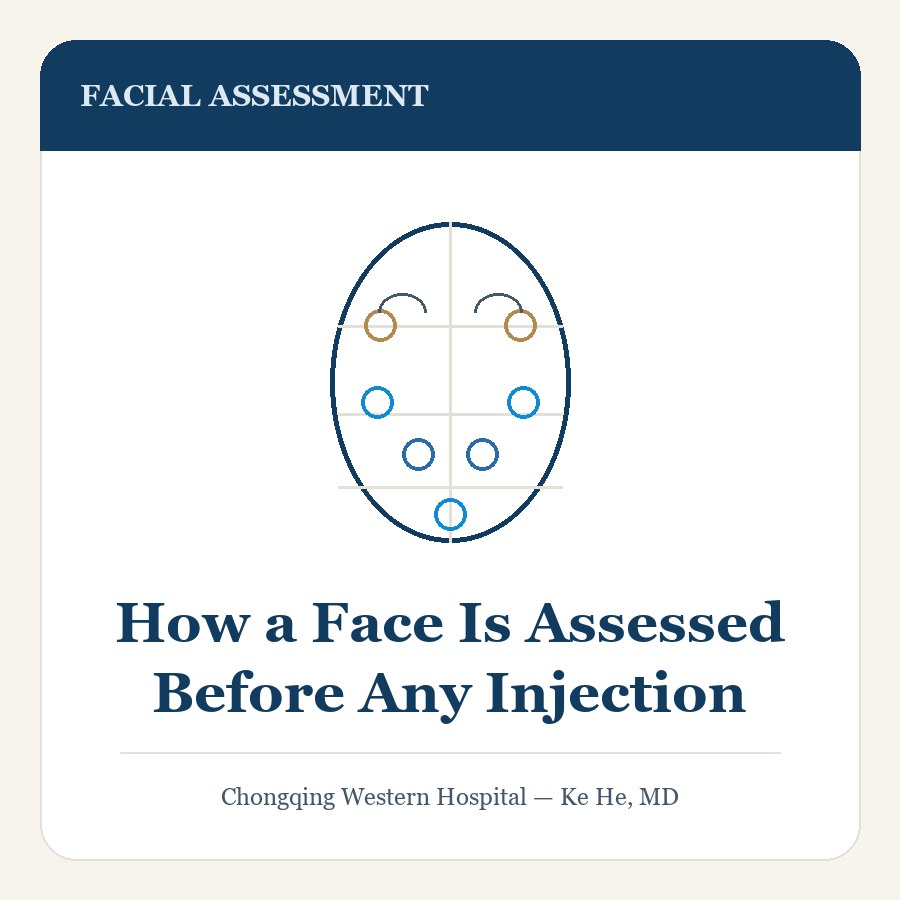
In short. Assessment before any injection means looking at movement, volume, skin quality and tissue support, and deciding which problem is actually being treated.
Key points
- The visible part of an appointment is brief.
- The assessment is the longer part, and it decides which problem is dominant, which substance class is relevant, what will be staged across visits, and whether injecting is the right choice this year.
Assessment happens before any syringe is opened, and it decides whether the treatment is a good idea at all. A face is not a menu of areas to be filled, and the reason two patients asking for the same thing may receive different plans — or no plan — is that different problems were found underneath the same request.
What the physician looks at
The face is examined at rest and in movement, because a line that appears only on movement and a line present at rest are different problems. Asymmetry is noted, since most faces have some. Volume loss is assessed by zone, as the temples, mid-face, tear trough and jaw behave differently. Skin quality is judged separately from shape, and tissue laxity is checked, because a sagging face does not need filling. Previous treatments and their residue are recorded.
Four problems, four different tools
A movement problem is treated by relaxing the muscle that creates it. A volume problem is treated by restoring volume. A skin-quality problem is treated at the level of the skin. A laxity problem is structural, and injections are usually the wrong tool for it. Naming the dominant problem turns a request into a plan, and sometimes the correct recommendation is a surgical consultation.
Medical history and medications
Several things change the risk of a straightforward injection. Medications and supplements that increase bleeding or bruising risk matter. Allergy history matters. Pregnancy and breastfeeding change what can reasonably be done. Autoimmune and neuromuscular conditions affect suitability and monitoring. Expectation matters too: a request for a result no injectable can produce is a reason to talk, not to proceed.
Photographs and consent
Standardised photographs are part of the clinical record, not marketing material, and they allow honest comparison at review. Consent is a conversation: the temporary nature of the result, the risk of bruising, swelling and vascular occlusion, and the plan for review are all stated before anything begins.
Why a template plan fails
A plan copied from a template — the same areas, for every face — treats the request rather than the face, and removes the step where a physician would have noticed a different dominant problem. Good results come from assessment willing to change the plan, and sometimes to cancel it.
Assessment is the treatment
The visible part of an appointment is brief. The assessment is the longer part, and it decides which problem is dominant, which substance class is relevant, what will be staged across visits, and whether injecting is the right choice this year.
When the answer is not to inject
There are faces for which an injection is not the right next step: where laxity dominates, where the request is for a change no injectable produces, where a medical condition makes the risk unreasonable, or where the patient is not ready to accept a temporary result. Saying so is part of the assessment, not a failure of it.
Tell the assessing physician
- Every medication, supplement and herbal product you take, especially anything that affects bleeding or immunity.
- Any previous injectable, filler or thread treatment, and what you were told was used, where and when.
- Pregnancy, breastfeeding or a planned pregnancy, and any autoimmune, neuromuscular or bleeding condition.
Frequently asked questions
Why does the same request produce different plans for two patients?
Because the dominant problem underneath can differ. A movement problem, a volume problem, a skin-quality problem and a laxity problem each need a different tool, and only examination at rest and in movement tells them apart.
Why does a sagging face not simply need filling?
Laxity is structural. Adding volume to a descended face increases weight without restoring support and often makes it look heavier. Where laxity dominates, the honest recommendation is a surgical consultation rather than an injection, and saying so is part of the assessment.
When is the answer not to inject at all?
When laxity dominates, when the request is for a change no injectable produces, when a medical condition makes the risk unreasonable, or when the patient is not ready to accept a temporary result. Saying so is part of the assessment, not a failure of it.
Risks & Limitations
- Vascular occlusion — a time-critical emergency in which filler blocks a blood vessel. It can cause skin loss and, rarely, blindness.
- Nodules, lumps or granuloma formation, which may need treatment or dissolution.
- Infection at the injection site.
- Asymmetry or over-correction; over-treatment is harder to correct than under-treatment.
- Migration of filler away from the intended area.
- Temporary brow or eyelid droop after botulinum toxin, which resolves as the effect wears off.
- Bruising and swelling. All injectable results are temporary and maintenance is required.
When to Seek Care
- Severe pain out of proportion to the procedure, or skin turning white, grey, mottled or dusky — this is a vascular emergency; seek care immediately.
- Any change in vision — seek emergency care immediately.
- Fever, spreading redness, warmth or pus at an injection site.
- A hard, painful lump that is growing.
- Drooping eyelid, difficulty swallowing, or difficulty breathing after botulinum toxin.
References & Further Reading
- American Academy of Dermatology (AAD) — injectable safety information
- American Society of Plastic Surgeons (ASPS) — injectable guidance
- U.S. Food and Drug Administration (FDA) — approved filler and neurotoxin products
- National Medical Products Administration (NMPA, China) — approved product status
This page is patient education, not medical advice, and it does not cite individual studies. Discuss your own case with a qualified clinician. To arrange an assessment at Chongqing West District Hospital, see Contact & Consultation.